
IPCEI news: EuBatIn officially launched in November 2021

Guest article by the EuBatIn Governance Facilitation Group *
The year 2021 has come to an end and we would like to take the opportunity to look back on this exciting, eventful and dynamic year. In January 2021, we received the state aid clearance for the IPCEI EuBatIn and successfully kicked off its governance structure in September 2021.
The overarching goal of the EuBatIn project is to establish a closed, sustainable and innovative value chain for lithium-ion battery technology in the EU. All parts of this added value are to be considered, from material production to cell development and production to the final storage systems for various applications. The partner network deals with all these aspects.
The main feature of the EuBatIn work is a holistic approach. The lithium-ion technology is the key component with which a more sustainable mobility and energy supply can be realised. However, this is only possible if the production of the cells and storage units is also designed and laid out in accordance with sustainable aspects. The EuBatIn has set itself the task of taking on a pioneering role in this area. Together with its partners, the program will establish a closed loop. By establishing recycling processes, efficient and sustainable production processes and the latest innovative materials and technologies, the lithium-ion storage product is to be further developed into a real green technology.
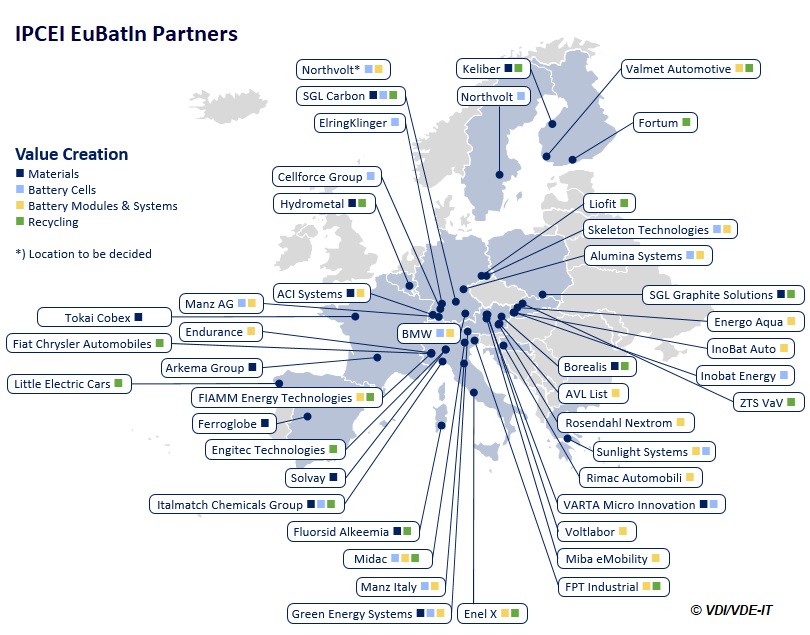
Workstream 1 on "Raw and Advanced Materials" aims to advance European battery raw material production, the chemical processing and to develop a sustainable, fully integrated European value chain. In addition, recovering as well as the re-use of materials from recycling processes is targeted in order to create a closed loop. The reduction of critical cobalt content on the cathode side, the replacement of critical raw materials required on the anode side as well as potentially the use of natural graphite or novel synthetic graphite alternatives from Europe will be intended while considering technological feasibility as well as economic and environmental aspects. The workstream consists of 13 partners (projects) from eight European countries. Eleven partners started their projects already, whereas three of them are delayed according to the initial project plan and two will start by 2022.
Workstream 2 on "Battery Cells" of the IPCEI EuBatIn has the goal to develop and industrialise new and innovative battery cells and cell components. A particular focus is on the implementation of cost-effective, efficient, and sustainable production processes. The workstream consists of 15 awarded projects. Two started in 2020, five in 2021 and the remaining eight will officially start in 2022. As one of the achievements it can be mentioned that the building of several pilot production lines for battery cells with innovative electrolyte and electrode materials has started. Furthermore, cooperation and collaboration with renowned research institutions and European partners is ongoing and will be extended progressively in the coming years.
The overall goal of workstream 3, "Battery Systems", is to develop innovative processes for battery module assembly using industry 4.0, resulting in safer, more reliable and higher-performing battery systems equipped with advanced BMS (battery management system) for easier maintenance, control and support. The design of the battery systems will enable optimised battery assembly, easy disassembly and dismantling, and a cost-effective recycling process. Sustainability will also be ensured through standardisation, modularity and connectivity, leading to a significant reduction in the carbon footprint. The achievements are mainly related to the acquisition of test equipment, the testing of some R&D solutions, the planning of FID facilities and the better definition of the content and scope of joint cooperation. The outlook for 2022 is mainly towards the continuation of these activities with testing of the different solutions identified, the construction of the facilities and the recruitment of the necessary personnel. The workstream consists of 20 direct partners.
Including "Recycling and Sustainability" in workstream 4 among the pillars of the EuBatIn Project means developing novel dismantling, repurposing, recycling, and refining processes, allowing to effectively recycle batteries, ultracapacitors and other waste containing metals important for e-mobility. All results will be reached through the adoption of a systemic approach in compliance with the Green New Deal from design to recycle and from second life reuse down to secondary raw materials’ recovery processes. A sustainability label will be released to guarantee either deployment of the output technologies or results’ exploitation, in respect of the environmental and social benefits for the community. As the project is still in its initial phase with some national time deviations, achievements in 2021 were limited to kick off the various IPCEI partnering actions and to set the feasibility studies. 2022 will be a key year for R&D (research & development) actions towards the defined tasks at pilot phase with a special focus on the various recycling processes’ design. The workstream consists of 14 active partners.
Acknowledgements
IPCEI EuBatIn Facilitation Group Chairs:
Daniela Werlich, Cellforce Group (Germany) and Stefano Saguatti, Manz Srl. (Italy)
EuBatIn Workstream 1 (Raw and Advanced Materials) Lead:
Stefan Koller, Varta Micro Innovation (Austria) and Peter Roschger, SGL Carbon (Germany)
EuBatIn Workstream 2 (Battery Cells) Lead:
Yannick Motcheu, ElringKlinger (Germany) and Jakub Simkovic, InoBat Auto (Slovak Republic)
EuBatIn Workstream 3 (Battery Systems) Lead:
Matteo Fedeli, Green Energy Storage (Italy) and Martin Weinzerl, AVL (Austria)
EuBatIn Workstream 4 (Recycling and Sustainability) Lead:
Maria Cristina Pasi, Italmatch Chemicals (Italy) and Jaakko Soini, Fortum (Finland)